
Nutrition: The 7pm Rule
One boundary instead of a diet. Close the kitchen at 7pm, make dinner your smallest meal of the day, and take at least 30g of protein with every meal — why that improves weight, fasting glucose, triglycerides and sleep, and how to actually do it.
The short version
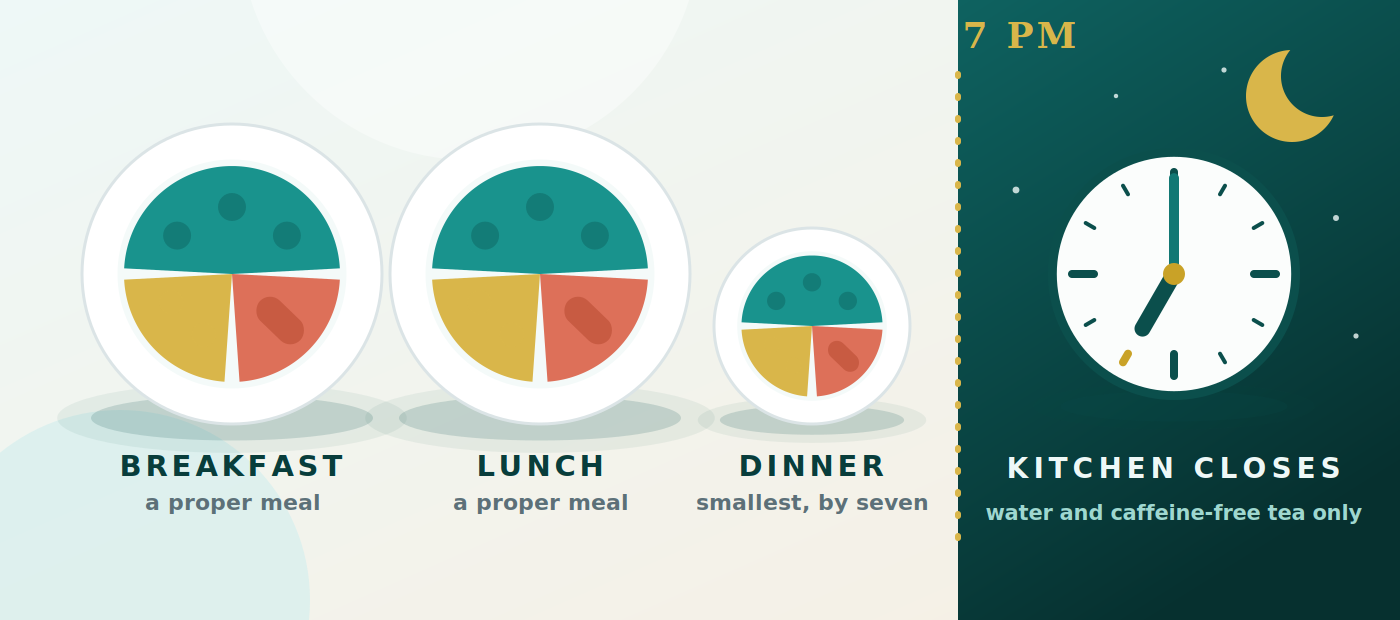
- Close the kitchen at 7pm. Three meals, no grazing afterwards. It works mostly because it deletes the extra eating that happens when nobody is hungry — tiredness, boredom, leftovers, a second biscuit tin.
- Dinner should not be your biggest meal. In a trial of two identical 1400 kcal diets that differed only in which meal was largest, the big-breakfast group lost more weight and more waist, and its triglycerides fell 34% while the big-dinner group’s rose 15%.
- Do not skip breakfast to save room for later. In type 2 diabetes, skipping it pushed glucose after lunch about a third higher — and after dinner too, hours later.
- At least 30g of protein with each meal — and eat it first on the plate. This is what makes the rule feel easy rather than heroic: fullness from protein, not from willpower.
- Hungry at dinner time? Take a high-protein snack 30–60 minutes before dinner. It works better than eating more dinner, and far better than eating after 7pm.
- Many people lose waist circumference and see fasting glucose, HbA1c and triglycerides drift down, sometimes before any weight change is visible.
- If you take insulin or a sulfonylurea, talk to your clinic first: the evening dose may need reducing.
What the 7pm rule actually is
Nutrition is key to maintaining a healthy body weight. I first worked out the 7pm rule with patients in the hospital lipid and diabetes clinic, and it has since helped a great many people — in that clinic and in my own practice — with diabetes and lipid disorders. It is deliberately small:
There is no food list to follow, nothing weighed, no carbohydrate counted. Dinner can be at 6pm or 6.45pm; what matters is that the eating window ends at a fixed clock time every night, and that it does not slide sideways as the evening goes on.
For most people this creates an overnight fast of about 12–13 hours. That is a side effect rather than the point — but it happens to be the window in which insulin levels fall lowest and the liver clears fat from the blood most efficiently.
The full version has three parts, and they do different jobs:
- Stop eating at 7pm — this removes the uncounted calories.
- Keep dinner the smallest meal of the day, and do not skip breakfast. This changes how those calories are handled.
- At least 30g of protein with every meal, plus a small protein snack before dinner if you arrive hungry. This is what makes the first two bearable.
Why such a small rule does so much
1. It removes the calories nobody counts
Evening eating is rarely hunger-driven. It is habitual, opportunistic and usually energy-dense: biscuits while dishes are done, the packet of chips in front of a series, finishing the children’s leftovers. For many patients that single window accounts for several hundred kilojoules a day — enough on its own to explain a slowly climbing weight and triglycerides.
2. Your body is less forgiving at night
Insulin sensitivity follows a daily rhythm: for the same meal, glucose and insulin responses are higher in the evening than in the morning. Late eating also pushes food and bile-acid cycling into the hours when the liver is meant to be clearing triglyceride-rich particles, which shows up on bloods as a higher fasting triglyceride.
3. It improves sleep — which improves everything else
Eating late disturbs sleep for many people: reflux, a raised core temperature, and nocturnal glucose swings that cause 3am waking. Better sleep lowers appetite-driven hunger the next day, so the rule feeds itself.
Dinner should not be the biggest meal of the day
The clock is only half the rule. The other half is size: most people eat the largest meal of the day at the exact time of day when their body has least capacity to handle it. A coffee and toast at 7am, a sandwich at noon, then the biggest plate at 8pm. The 7pm rule asks you to tilt that pattern back the other way — breakfast and lunch bigger, dinner smaller.
What usually happens
What the rule asks for
The trial behind it
Women with metabolic syndrome were randomised to two weight-loss diets containing exactly the same calories — about 1400 kcal a day for 12 weeks. Only the distribution differed: one group ate 700 kcal at breakfast, 500 at lunch and 200 at dinner; the other reversed it (200, 500, 700). The big-breakfast group lost more weight and more waist circumference. Fasting glucose, insulin and insulin resistance all fell further. Triglycerides fell 34% in the breakfast group and rose 15% in the dinner group. And this was not a triumph of willpower: measured hunger scores were lower and fullness scores higher, all day, in the people eating the big breakfast.
Jakubowicz D, Barnea M, Wainstein J, Froy O. Obesity 2013 — PMID 23512957
What the animal work shows
Timing can be controlled far more tightly in a laboratory, and the effect there is even starker. In the original time-restricted feeding experiments from Satchin Panda’s group at the Salk Institute, mice fed a high-fat diet were given food only during the first 8 hours after they woke (mice start their active night when the lights go off), then fasted for the remaining 16. Those mice ate exactly the same number of calories as mice allowed to graze around the clock — and were protected against obesity, high insulin, fatty liver and inflammation. The calories were identical; only the clocking differed, with most intake early in the waking period and a long clean fast at the end.
Later work from the same field went further: when the eating window was placed early rather than late, mice lived longer. Nothing about this is mouse-specific logic — it is the same circadian machinery you have, running on the opposite schedule to your social life.
Hatori M…Panda S. Cell Metab 2012 — PMID 22608008; Acosta-Rodriguez G…de Cabo R. Science 2022 — PMID 35511946
If the idea of a small dinner feels impossible
Do not start by shrinking dinner — start by making breakfast and lunch real meals with protein in them. A large part of evening hunger is simply an unpaid debt from earlier in the day. Move 200–300 kcal from your plate at night onto your plate in the morning and give it two weeks; most people find the dinner portion settles on its own.
Do not skip breakfast
You do not have to make breakfast the biggest meal of the day. The point is only that dinner should be the smallest. But “I’ll skip breakfast and eat less later” is the most common way people try to bend this rule, and it goes in the wrong direction — not just because of evening hunger, but because of what it does to your glucose. In a randomised crossover trial in people with type 2 diabetes, exactly the same 700 kcal lunch and dinner were eaten on two days: one after a normal breakfast, one having fasted until noon.
| After skipping breakfast | Lunch | Dinner |
|---|---|---|
| Glucose exposure (3-hour area under the curve) | +37% | +27% |
| Free fatty acids — higher means more metabolic stress | +41% | +30% |
| Insulin response | −17%, peak 30 min late | −8% |
| GLP-1, the hormone that tells your brain you are full | −19% | −17% |
One skipped breakfast made both remaining meals harder to handle — glucose higher after lunch and, hours later, after dinner, even though those plates were identical to the days breakfast was eaten. Skipping does not delete those calories; it moves them onto a worse insulin response and into the evening. So eat a normal breakfast with protein in it — eggs, yoghurt, oats with milk, whatever you actually like — if for no other reason than so you are not white-knuckling your way to 7pm.
Jakubowicz D, Wainstein J, Ahren B, Landau Z, Bar-Dayan Y, Froy O. Diabetes Care 2015 — PMID 26220945
At least 30g of protein with every meal
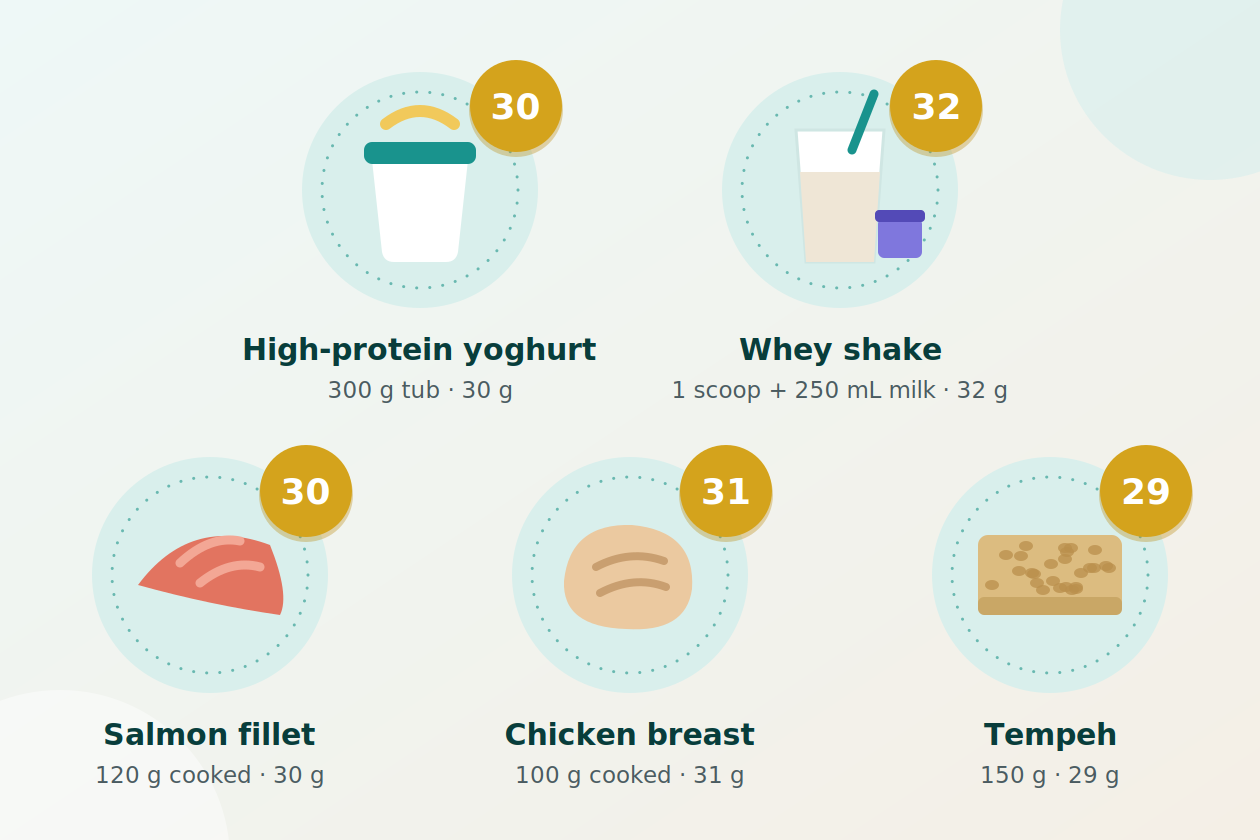
This is not a high-protein-athletes thing. It is the practical reason patients manage to stop eating at 7pm without misery. The target in my clinic is deliberately simple, with no sums to work out: at least 30 g of protein with each meal. Not 30 g once a day in a shake, and not all of it piled onto dinner — 30 g with breakfast, 30 g with lunch, 30 g with dinner. Most people in New Zealand eat around 15 g at breakfast, wonder why they are starving by evening, and blame their willpower.
- Protein is the most filling nutrient per kilojoule. It lowers ghrelin (hunger) and raises the fullness hormones GLP-1 and PYY, which is exactly the deficit that drives 9pm grazing. Adequate protein across the day makes it easier to stick to the rule.
- It protects muscle while you are losing weight — and after 60 it protects muscle full stop. Losing fat and strength together is a bad trade; the scale does not tell you which one you got.
- Eat the protein first, then vegetables, then the carbohydrate. Many patients get visibly lower 2-hour readings from the same plate purely by changing the order it goes in.
If you would rather build from single foods
| Food | Roughly |
|---|---|
| 3 eggs (any style) | 19–20 g |
| Greek yoghurt, 200 g tub | 18–20 g |
| Milk or soy milk, 500 mL (two large glasses) | 16–18 g |
| Porridge made with 500 mL milk, plus a spoon of peanut butter | ~25 g |
| Cottage cheese, 1 cup | ~25 g |
| Tin of tuna or salmon in water, drained | 25–30 g |
| Chicken breast, 120 g cooked (a palm) | ~35 g |
| Lean beef mince, 120 g cooked | ~30 g |
| Firm tofu, 200 g | 28–32 g |
| Cooked lentils or chickpeas, 1½ cups | 20–23 g |
| Protein powder shake, one scoop | 20–25 g |
Nuts, cheese and nut butters are healthy but are not protein solutions: 30 g of nuts brings about 5 g of protein and 900 kJ.
Hungry at dinner? Eat protein 30–60 minutes before it
If you get home ravenous, a large dinner is already lost: you will eat fast, over-eat, and then want something sweet anyway. The fix is to take 20–30 g of protein 30–60 minutes before dinner — on top of the 30 g you eat with the meal itself, not instead of it — rather than eating a bigger dinner, and certainly nothing after 7pm.
- Greek yoghurt, or cottage cheese with fruit
- Two boiled eggs
- A large glass of milk or soy milk, with a few nuts if you are not watching kilojoules closely
- A small protein shake made with water
- A handful of edamame, or last night’s leftovers weighed rather than nibbled
This is not a licence to snack more. Protein taken half an hour before a meal reduces how much you eat at it, so total intake usually stays level or falls — and the point of the exercise is that the eating happens on your side of 7pm rather than after it. If weight is not moving after two weeks, choose the lower-energy options in that list (milk, yoghurt, edamame) over nuts and granola bars.
If you take mealtime insulin or a sulfonylurea, treat this as a real snack with real carbohydrate in it: count it, and discuss the timing with your diabetes team before you start doing it daily.
How to start this week
In my own clinic, people eating this way — particularly with triglycerides that start very high — are usually measuring better insulin sensitivity within a couple of weeks: lower fasting glucose, lower morning insulin, and doses that need reducing.
Common obstacles
| Situation | What works |
|---|---|
| “I get hungry at 10pm.” | Usually too little protein earlier in the day, or dinner genuinely too early. Take 20–30g of protein 30–60 minutes before dinner (yoghurt, two eggs, a glass of milk), make sure dinner holds a palm or two of protein and half a plate of vegetables, then close the kitchen. |
| “I’m not hungry in the morning.” | Do not force porridge; drink something with protein in it (milk, soy milk, yoghurt, a small shake) within an hour of waking and eat a real meal an hour later. Appetite follows within about a week. |
| “Dinner is when the family eats together.” | Keep the shared dinner — change its size instead. Serve smaller portions of carbohydrate at night, keep protein and vegetables generous, and put the extra food into breakfast and lunch the same day. |
| Shift work or late finishes | Keep the rule but move it: eat your main meal when you get home and close the kitchen 2–3 hours before bed. The principle is the gap, not the clock face — and whichever meal falls latest in your day should still be the smallest. |
| Social events, dinners out | Plan for two or three exceptions a month rather than pretending they will not happen. Then return to 7pm the next night — do not “make up” for it. |
| “The evening coffee or tea is my ritual.” | Keep the mug, change what is in it. Nothing with caffeine after 7pm at all — and if you sleep badly, stop caffeine by early afternoon instead (caffeine and sleep). Herbal tea, rooibos or plain hot water do the ritual just as well. |
| Alcohol | Alcohol before 7pm still counts as drinking, and it removes the brake on whatever follows it. Most people find the food after the wine is the problem, not the wine. |
| Hypoglycaemia at night | Talk to your clinic. Do not manage this by adding a bedtime snack on top of an unchanged insulin or sulfonylurea dose; the regimen usually needs adjusting instead. |
What it will not do
The 7pm rule is not a treatment for diabetes by itself, and it does not fix a diet that is short on vegetables, protein and fibre at other times of day. It is the simplest single boundary I know for reducing intake without counting — a foundation to build the rest on. The protein target and the “dinner last and smallest” principle are what turn it from a fast you keep for nine days into an eating pattern you keep for years.
Where this advice comes from
- Jakubowicz D, Barnea M, Wainstein J, Froy O. High caloric intake at breakfast vs dinner differentially influences weight loss of overweight and obese women. Obesity 2013;21(12):2504–12. — the isocaloric big-breakfast vs big-dinner randomised trial (weight, waist, triglycerides −34% vs +15%). PMID 23512957
- Jakubowicz D, Wainstein J, Ahren B, Landau Z, Bar-Dayan Y, Froy O. Fasting until noon triggers increased postprandial hyperglycemia and impaired insulin response after lunch and dinner in individuals with type 2 diabetes: a randomized clinical trial. Diabetes Care 2015;38(10):1820–6. PMID 26220945
- Hatori M, Vollmers C, Zarrinpar A, et al. (Panda S). Time-restricted feeding without reducing caloric intake prevents metabolic diseases in mice fed a high-fat diet. Cell Metab 2012;15(6):848–60. — identical calories, food confined to the start of the active phase. PMID 22608008
- Acosta-Rodriguez G, et al. Circadian alignment of early onset caloric restriction promotes longevity in male C57BL/6J mice. Science 2022;379(6637):1192–1202. — an early eating window outperformed a late one. PMID 35511946
- Leidy HJ, et al. The role of protein in weight loss and maintenance. Am J Clin Nutr 2015;101(6):1320S–9S. — the evidence behind spreading protein across the day rather than piling it onto dinner. PMID 25926512
Trials in humans are modest in size and mostly short; the meal-timing effect is real but it is not a licence to ignore total intake, medication or your own bloods. Bring this page to your next appointment and we will fit it around what you are already taking.
In this series: aerobic exercise, then seven steps to better sleep. Similar to exercise, it is crucial to incorporate nutrition habits you can keep for years rather than weeks.
Written by Dr Huan Chan. Last reviewed: September 2026. General information only — it does not replace advice from your own diabetes or heart team.